The JMeter Alternative for Teams Who’ve Outgrown Open Source But Can’t Stomach LoadRunner Prices

Disclosure: OctoPerf is a TestGuild sponsor. All opinions are my own.
Here’s a pattern I’ve seen over and over again across 590+ podcast interviews and 30 years in this field.
I can’t tell you how many times I’ve heard about QA teams getting hit with budget cuts.
And when budgets get tight, performance testing tools often end up under the microscope first.
It usually starts when a LoadRunner or NeoLoad renewal lands on someone’s desk. Leadership says, “Let’s go open source.”
Someone spins up JMeter.
Six months later, the same engineers who volunteered for the migration are buried in script maintenance, correlation headaches, and coordination overhead that their commercial tool handled for them.
Don’t get me wrong. JMeter works.
Plenty of smart teams run serious load tests with it every day. But the gap between running JMeter on a laptop and running it successfully at enterprise scale is where many migrations quietly stall.
And this is the exact buyer story the founders of OctoPerf told me they built the company around.
How do I know?
I don’t just jump on vendor trend wagons.
In fact, I’ve been tracking OctoPerf’s evolution since they presented a session at my 2018 PerfGuild conference, back when the conversation was just about scaling basic cloud loads.
To see how far they’ve come, I sat down for a technical session with Quentin HAMARD, OctoPerf co-founder, and Ouamar Nedil, their Director of Performance Engineering, to get real answers before writing this. I also watched their June 2026 webinar where they demoed their new MCP server integration live.
What I saw is worth sharing with anyone caught between the complexity of open source and the cost of legacy performance testing tools.
Cut Your Cost. Try OctoPerf Now
Quick Verdict: OctoPerf is an enterprise-grade load testing platform, available as SaaS and on-premises, built on JMeter under the hood. It’s built for teams stuck between the operational overhead of scaling open source JMeter and the renewal costs of legacy tools like LoadRunner or NeoLoad. It works best for HTTP-based web and API workloads. It’s not the right call if non-HTTP protocols are core to your environment.
The JMeter Trap Nobody Budgets For
So what is the JMeter trap?
In my experience, most teams don’t wake up one morning looking for a JMeter alternative.
They start by looking for a way to reduce the cost of tools like LoadRunner or NeoLoad.
Leadership wants to cut licensing costs, so the team gives JMeter a try.
Quentin confirmed this during our conversation:
“Most of the time they are using LoadRunner or NeoLoad and they have budget constraints, they say let’s go to open source. Then they try using JMeter on some projects and they realize it’s quite tedious, time consuming, and the production level they had with their previous solution is way less. That’s how most of the time they are looking for the right alternative.”
That’s really what people mean when they start searching for a JMeter alternative.
It’s usually not because they dislike open source. It’s because they underestimated the amount of work required to get and keep everything running at scale.
So what gets underestimated when teams go down the JMeter path?
Here are the three things I see come up most often.
Script complexity at scale. Correlation, data parameterization, environment parity, CI integration. JMeter can do all of it. Doing all of it well across dozens of applications with a lean team is a different job entirely.
Support when it matters. Ouamar told me that customers coming off JMeter consistently mention support as the thing they didn’t realize they’d miss. With open source, your support system is Stack Overflow and the goodwill of strangers. With big legacy vendors, it’s ticket queues across time zones. Neither is great when a release window is six hours away.
The false economy of free. The license cost drops to zero. The headcount cost doesn’t. I’ve talked to teams who spent more on contractor hours untangling JMeter correlation problems than they would have spent on a mid-tier SaaS license for the whole year. Free to start doesn’t mean cheap to run.
What stood out to me is that OctoPerf is trying to sit in the middle between open source flexibility and traditional enterprise tooling.
Whether that’s the right fit for your team depends on your environment, budget, and goals, which is exactly why the “not for you” section below exists.
Sponsors don’t always love that section, but readers do.
What OctoPerf Actually Does
OctoPerf is a cloud and on-premises load testing platform built on JMeter under the hood.
You get JMeter compatible execution wrapped in a browser based scripting studio, HAR import, scenario management, and SaaS load generators so you’re not babysitting your own grid.
Migration paths they highlight:
JMeter to OctoPerf import for teams that want to keep existing script investment but stop fighting the UI and ops layer.
BlazeMeter to OctoPerf plugin for teams on BlazeMeter who want a few click conversion. Quentin confirmed this on our call: “We built a BlazeMeter to OctoPerf migration plugin. Basically it can convert and move your BlazeMeter script to OctoPerf in just a few clicks.” Real proof of this: a leading retail group in France (Adeo) migrated 250 performance test scripts and 500 test scenarios from BlazeMeter to OctoPerf in their first year.
HAR recording into the scripting studio for teams rebuilding from browser traffic instead of porting old scripts.
My Take: I haven’t used OctoPerf hands on in recent years, so I’m not going to pretend I kicked the tires last week.
Say Bye To LoadRunner Forever. Try OctoPerf Now
The LoadRunner Alternative Case
If you’re searching for a LoadRunner alternative, you’re usually not looking for more features.
You’re looking for a way to justify the renewal bill.
I’ve talked to performance engineers for years who genuinely liked LoadRunner. The challenge wasn’t whether the tool worked. The challenge was defending the cost every budget cycle.
Add in the transitions from Mercury to HP to Micro Focus to OpenText, and it’s not surprising that many teams started reevaluating their options.
That’s not a knock on the product.
It’s just the reality of enterprise software purchasing.
OctoPerf targets BlazeMeter, NeoLoad, and LoadRunner users explicitly, according to Quentin.
Their pitch isn’t, “We support every exotic protocol LoadRunner had in 2009.” It’s, “You probably don’t need all that, and what you do need shouldn’t require a six-figure check.”
Of course, I wasn’t going to take that claim at face value.
I asked Quentin if he had any tangible proof, and he pointed me to the SNCF case study.
SNCF, one of Europe’s largest transportation companies, migrated from LoadRunner to OctoPerf and reduced its performance testing infrastructure from 10 servers to just 2. They also expanded OctoPerf usage across their software factory, which spans more than 1,500 applications, with 30 to 50 regular users using the platform.
That’s the kind of real-world result that gets my attention because it goes beyond marketing claims and shows what happened after a migration.
And then Quentin shared another example from Pearson.
Pearson’s story is the script migration proof point. Their Principal Performance Architect, Francisco Muniz, led the move off LoadRunner. About half of their complex legacy scripts were converted within a month.
During their high-stakes Back-to-School launch, they ran 32,000 virtual users concurrently, simulating complex teacher and student activity during a critical one-hour window.
First-day-of-school outages are the kind of thing nobody wants on their resume. They held.
That said, if your environment depends heavily on non-HTTP protocols, deep Citrix deployments, legacy proprietary systems, and similar use cases, OctoPerf may not be the right fit.
That’s not a small detail.
For some teams, it’s the deciding factor for what performance test tool they choose.
| OctoPerf | Legacy Tools (LoadRunner, NeoLoad) | |
| Primary use case | Modern web, API, HTTP-based load testing | Deep legacy, non-HTTP, proprietary protocols |
| Pricing model | All-inclusive, features not tier-gated | Complex, often protocol-based licensing |
| Scripting engine | JMeter-compatible, open standard | Proprietary scripting languages |
| Infrastructure | SaaS cloud generators or on-premises Docker | Often requires heavy dedicated on-premises servers |
| Migration path | JMeter import, BlazeMeter plugin, HAR recording | N/A |
| Support model | In-app chat, direct team access | Ticket queues, regional routing |
Still Not Sure? Try Our Test Tool Matcher
The BlazeMeter Alternative Angle
I’ve also talked to quite a few teams over the years that landed on BlazeMeter because it felt like a natural next step from JMeter.
But eventually the conversation changes.
Sometimes it’s about workflow. Sometimes it’s about cost.
And since the Perforce acquisition, I’ve heard more teams taking a fresh look at what they’re paying for and what they’re actually getting.
What stood out to me in my conversation with Quentin wasn’t another feature comparison. It was a migration story.
In my experience, script investment is what kills a lot of tool evaluations before they even get started.
A team might like a new platform, but the moment someone asks, “What happens to our existing scripts?” the room gets quiet.
That’s why the BlazeMeter migration plugin caught my attention.
If you can move existing projects without spending months rebuilding scripts and reworking correlations, the conversation changes from “Maybe next year” to “Let’s run a pilot.”
The example that got my attention came from Adeo, a large European retail group. They migrated 250 performance test scripts and 500 test scenarios in their first year.
When you’re evaluating alternatives, I’d focus less on feature checklists and more on questions like:
- What’s the pricing model?
- How much operational overhead am I taking on?
- What happens when something breaks the night before a release?
- How easy is it to onboard additional teams?
One example Quentin shared was again from SNCF.
They valued things like SSO, Azure integrations, centralized management, and Docker-based load agents because multiple teams and outside vendors could run tests without constantly fighting over infrastructure.
What OctoPerf Just Shipped: MCP Server Integration
Let’s face it, almost every vendor I spoke with this year seemed to have an AI slide in their deck.
In a lot of cases, it felt like the marketing was ahead of the product.
OctoPerf took a different approach.
Quentin told me they didn’t want to rush AI into the product just because everyone else was doing it.
Instead, they spent time figuring out what would actually be useful, secure, and valuable for customers.
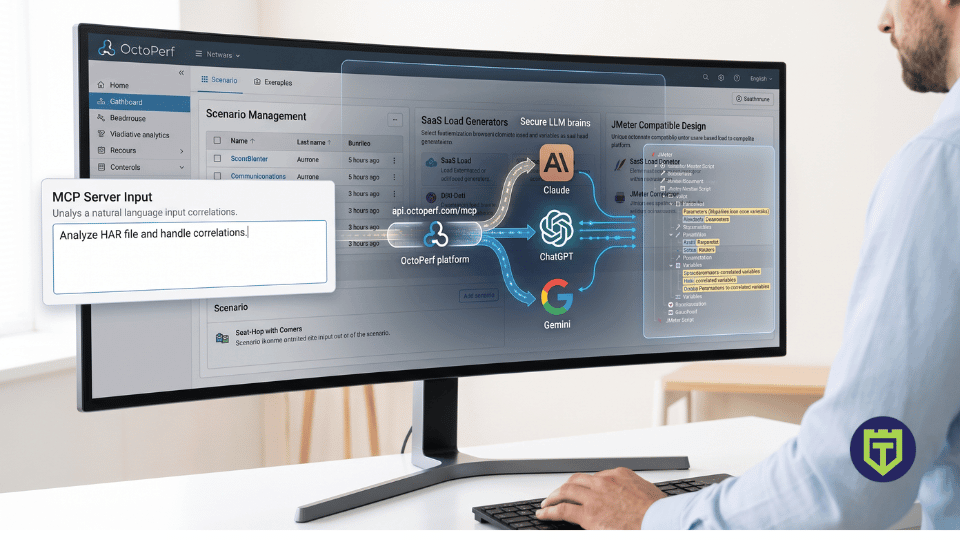
What they ended up shipping is an MCP server hosted by OctoPerf that connects to whatever LLM you prefer, Claude, ChatGPT, Gemini, Mistral, or even a local model running inside your own network.
Because it’s connected directly to the OctoPerf API, it can help with things testers spend time on every day: scripting, correlation, variable management, test strategy, test execution, result analysis, and reporting. You interact with it using natural language instead of hunting through menus.
During the webinar, Ouamar walked through a full workflow using Claude.
He recorded a user journey using HAR, then asked Claude to analyze the virtual user and handle the correlations. Claude automatically identified three dynamic parameters, explained what they were, created the correlation rules, backed up the script, and applied the changes.
He never had to touch the UI.
The part that really caught my attention was what happened next.
When his on-premises load generator went down during the demo, the AI automatically switched to his preferred cloud region in Paris because it had learned that preference from previous sessions.
That may sound like a small detail, but that’s exactly the kind of thing that matters when you’re trying to get a test running a few hours before a release.
Ouamar also made a point during the webinar that I think a lot of teams need to hear:
“I’m not going to ask Claude for every virtual user code to handle the dynamic parameters…”
Which brings up a great point: Use AI where it saves meaningful time. Don’t use AI for things your tooling already handles efficiently.
One thing I specifically asked Quentin about was AI-driven migration from LoadRunner and NeoLoad.
He told me they’re actively exploring it using MCP agents. It’s not available today, but it’s something they’re investigating.
Another detail worth mentioning: the MCP capability is included with every OctoPerf license, including the free tier, so there isn’t an additional charge to use it.
Quentin also told me on-premises MCP support is planned for the next release.
The idea is that you’ll be able to host the MCP server yourself and keep everything inside your own network without sending data to Anthropic or OpenAI.
What’s Coming: Test as Code
OctoPerf says test-as-code support is on the roadmap for the end of 2026.
The idea is to bring JMeter, no-code scripting, AI-assisted testing, and test-as-code approaches together under one roof.
If they can pull that off, it addresses one of the biggest reasons I still see teams gravitating toward developer-focused tools like k6.
Of course, roadmaps are easy. Shipping is harder. So this is one I’ll revisit when it’s actually in customers’ hands.
Who This Is For
Based on everything I saw, OctoPerf seems like a good fit for teams that:
- Already use JMeter or are trying to move off LoadRunner, NeoLoad, or BlazeMeter
- Want browser-based scripting and SaaS load generation without building and maintaining their own infrastructure
- Have significant script investments and need migration paths instead of starting over
- Run performance testing at enterprise scale and prefer predictable, all-inclusive licensing
- Value having someone to call when a critical test run doesn’t go as planned
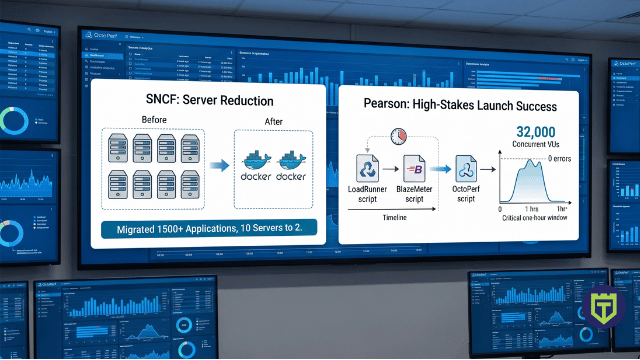
The customer stories they shared also paint a pretty clear picture of who tends to get the most value from the platform.
- SNCF represents centralized platform teams trying to standardize performance testing across large organizations.
- Pearson represents teams with high-stakes release windows where outages simply aren’t an option.
- Adeo represents organizations facing large migration efforts where existing script investments can’t be thrown away.
Who This Is NOT For
This probably isn’t for you if non-HTTP protocols dominate your environment and you rely heavily on the deep legacy protocol support that made LoadRunner famous.
It’s also probably not for you if you’re a solo developer running the occasional smoke test on a side project. JMeter on your laptop is likely more than enough.
Don’t buy enterprise-grade performance testing infrastructure to test a CRUD app twice a year.
And if you’re hoping AI will replace performance engineering expertise this quarter, I’d set expectations accordingly.
The MCP integration is real, and it’s already in production. But someone still has to define thresholds, interpret results, and have those conversations with developers when bottlenecks show up.
As Ouamar put it during the webinar, the AI learns your process and helps accelerate it. It doesn’t replace the person who understands what the results actually mean.
Finally, this may not be a fit if your procurement process requires a perfect feature-for-feature match with NeoLoad or LoadRunner before anyone is willing to run a pilot. At some point, you have to test whether a different approach works in your environment instead of evaluating everything through a checklist.
How to Evaluate OctoPerf
If you’re trying to decide between sticking with JMeter and renewing a legacy tool like LoadRunner or NeoLoad, don’t start with a feature checklist.
Start with a pilot.
Pick a script that’s important to your business. Import what you already have. Then see how much effort it takes to get from script import to useful results.
That’s going to tell you a lot more than any sales deck.
Before talking to anyone, I’d also spend some time reviewing the SNCF and Pearson case studies.
Those were the two examples that stood out most during my research.
If you’re currently using BlazeMeter, ask about the migration plugin. If your team is already experimenting with AI-assisted workflows, ask for a demo of the MCP integration. And don’t overlook the free tier. It may be enough to answer most of your questions before you spend a dollar.
If it sounds like a fit, head over to OctoPerf and ask them to evaluate one of your real-world scripts. You’ll learn a lot more from that than a generic product tour.
Full disclosure: OctoPerf is a TestGuild sponsor, which helps support the free content, podcasts, webinars, and resources we create for the testing community.
That said, I only cover tools I believe can solve a real problem for a specific audience. If OctoPerf isn’t the right fit, check out the Tool Matcher for other performance testing options.
Frequently Asked Questions
What is OctoPerf?
OctoPerf is an enterprise-grade load testing platform available as SaaS and on-premises that runs JMeter compatible tests through a browser based interface with cloud or on-premises load generators. It targets teams who have outgrown manual JMeter operations or want to migrate off expensive legacy tools like LoadRunner and NeoLoad without giving up enterprise scale testing. You can import JMeter projects, record HAR files directly into scripts, and manage scenarios, runtime settings, and results in one place. It’s used by organizations like SNCF and Pearson for high stakes, large scale performance testing.
Who is OctoPerf built for?
OctoPerf is built for performance engineers, platform teams, and QA leads at mid size to large organizations running regular load tests across multiple applications. SNCF standardized performance practice for a software factory spanning over 1,500 applications. Pearson used it for high stakes seasonal traffic with 32,000 concurrent virtual users. Adeo used it to migrate 250 scripts and 500 test scenarios off BlazeMeter in their first year. It’s a weaker fit for hobby projects, teams whose testing is entirely non-HTTP protocol based, or organizations that won’t invest time in a pilot migration before committing.
Is OctoPerf a good JMeter alternative?
It’s a strong JMeter alternative when your pain is operational, not ideological. JMeter is the engine underneath, but OctoPerf adds hosted load generation, visual scripting, HAR import, and commercial support. SNCF reduced their test infrastructure from 10 servers to 2 after migrating. Pearson converted about half their LoadRunner scripts within one month. I haven’t run independent benchmarks for this article, so validate against your specific scripts and protocol requirements before you commit budget.
How does OctoPerf compare to LoadRunner?
LoadRunner wins on long tail enterprise protocol coverage and decades of incumbency in enterprise RFPs. OctoPerf wins on cost, modern UI, JMeter ecosystem compatibility, and migration paths for teams whose workloads are mostly HTTP based web and API traffic. SNCF cut infrastructure from 10 servers to 2 after moving off LoadRunner. Pearson converted half their LoadRunner scripts in a month with structured change management. If your LoadRunner estate is deeply proprietary or protocol-heavy beyond HTTP, plan a careful pilot before assuming parity.
How does OctoPerf compare to BlazeMeter?
Both platforms are built on JMeter conceptually. OctoPerf offers a dedicated BlazeMeter to OctoPerf migration plugin for script conversion and emphasizes all-inclusive licensing where features aren’t tier gated. Adeo migrated 250 scripts and 500 test scenarios from BlazeMeter to OctoPerf in year one, which is a real migration proof point. Compare your current BlazeMeter CI integrations and agent topology against OctoPerf’s Docker split agents and factory style workspace model if you’re at enterprise scale.
Does OctoPerf use AI for performance testing?
Yes, and it’s in production now, not on a roadmap slide. OctoPerf shipped an MCP server integration that lets any LLM (Claude, ChatGPT, Gemini, Mistral, or a local model) drive scripting, correlation handling, test configuration, execution, and result analysis through natural language. It’s included in every license including the free tier at no extra cost. On-premises support is coming in the next release. Quentin was direct about their approach: they didn’t rush AI to market. They spent time figuring out what would actually be useful and secure before shipping. That framing matches what I saw in the live demo.
How do I get started with OctoPerf?
Pick one representative application, export your existing JMeter or BlazeMeter scripts, and run the same scenario through OctoPerf’s import flow.
OctoPerf’s documentation covers HAR capture, scripting studio basics, and SaaS load generator setup. For enterprise rollouts, ask about SSO and cloud integrations if you’re centralizing performance practice across a platform team. For the MCP integration, the server connects via api.octoperf.com/mcp and works with any LLM client that supports MCP server connections. Start at octoperf.com and request a demo with real scripts, not a standard demo account.
Related TestGuild Resources
- TestGuild Tool Matcher — not sure which load testing tool fits your situation? Start here.
- TestGuild Podcast — 580+ episodes on performance, automation, and QA practice.

Joe Colantonio is the founder of TestGuild, an industry-leading platform for automation testing and software testing tools. With over 25 years of hands-on experience, he has worked with top enterprise companies, helped develop early test automation tools and frameworks, and runs the largest online automation testing conference, Automation Guild.
Joe is also the author of Automation Awesomeness: 260 Actionable Affirmations To Improve Your QA & Automation Testing Skills and the host of the TestGuild podcast, which he has released weekly since 2014, making it the longest-running podcast dedicated to automation testing. Over the years, he has interviewed top thought leaders in DevOps, AI-driven test automation, and software quality, shaping the conversation in the industry.
With a reach of over 400,000 across his YouTube channel, LinkedIn, email list, and other social channels, Joe’s insights impact thousands of testers and engineers worldwide.
He has worked with some of the top companies in software testing and automation, including Tricentis, Keysight, Applitools, and BrowserStack, as sponsors and partners, helping them connect with the right audience in the automation testing space.
Follow him on LinkedIn or check out more at TestGuild.com.
Related Posts

Quick Answer Browser-based load testing (also called real-browser load testing) drives real browser sessions through your critical user journeys under […]

HTTP is the protocol web browsers, mobile apps, and test tools use to request information from a server and receive […]

What is Throughput in Performance Testing? Throughput is the amount of work an application completes over a given period. In […]
Concurrent users are the people or virtual users who are active in an application during the same time window. They […]