Vibium: The Next Evolution in Test Automation from Selenium’s Creator
What Is Vibium?
Jason Huggins, the original creator of Selenium, Appium, and co-founder of Sauce Labs, is building his next foundational testing tool. He describes Vibium simply:
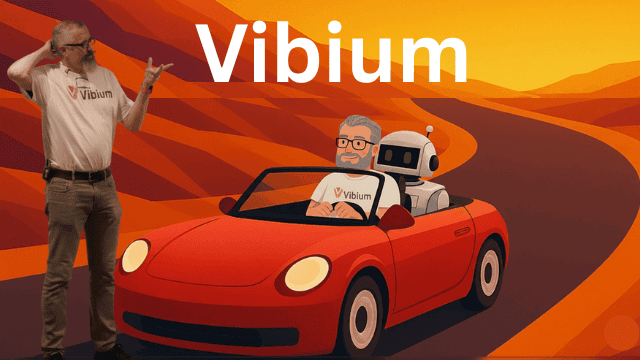
Vibium is Selenium Test Automation for AI. Whatever we did with Selenium for the web, whatever we did with Appium for mobile, we are doing with AI.
Vibium aims to be the next open-source standard for software testing—designed from the ground up for AI-driven development and testing workflows.
* FYI this post will be updated as Vibium evolves. Also the insights in this article come directly from Jason Huggins through his Test Guild Automation Podcast interview and his keynote at TestGuild IRL Chicago, where he revealed Vibium Atlas for the first time.
Why Vibium? Why Now?
Jason sees a clear pattern in his career:
Selenium → Web testing
Appium → Mobile testing
Vibium → AI-era testing
As AI becomes the dominant platform for software development, Huggins is creating testing infrastructure to ride that wave, just as he did when web and mobile became mainstream.
The Technical Foundation: WebDriver BiDi
At its core, Vibium implements the WebDriver BiDi specification—a WebSocket-based protocol that solves the flakiness and performance issues of the original HTTP-based WebDriver.
Think of it as Selenium rebuilt with modern architecture:
- Faster communication through WebSockets instead of REST
- Bi-directional real-time updates from the browser
- Built-in stability that Playwright and Puppeteer pioneered
Jason positions this as answering the question: “If you wanted Selenium to stop being flaky, what would you do differently?” The answer: start with WebSocket-based communication.
Chat About Vibium in our Community
How AI Changes Testing with Vibium
Vibium doesn’t just add AI on top of existing automation—it fundamentally rethinks the architecture:
- Intelligent Fallback Instead of Failure
Traditional WebDriver fails with “element not found.” Vibium can ask an AI for help when stuck, potentially finding alternative paths to continue the test rather than immediately failing. - Automatic Application Mapping
Vibium revives “model-based testing” by automatically generating application maps from real user interactions—eliminating the manual labor that previously made this approach impractical.
Think of it like Google Street View for your application: By instrumenting your app and recording events as users navigate through it, Vibium builds a navigational model of workflows and paths. - Vibium Atlas: Visualizing Your App
Jason demonstrated Vibium Atlas—a visual interface showing your application as nodes (pages) and edges (actions connecting them), similar to Google Maps but for software workflows. This isn’t just pretty visualization; it’s the foundation for intelligent test generation.
Open Source Philosophy
True to his roots, Jason promises:
There has to be an open source reference implementation that you can download and never have to give me money or use my service.
Vibium will offer:
- Free open-source libraries (JavaScript, Python, likely Java)
- Local/on-premise deployment options
- Support for open-weight LLMs (Llama, Qwen) alongside commercial options
- Optional SaaS services for teams wanting managed infrastructure
Breaking with Tradition: Beyond Page Objects
Jason is “killing page object models” in favor of what he calls “MAP” (Model for Adaptive Path)—a paradigm where tests constantly adapt to changes rather than failing when encountering unexpected states.
Instead of brittle scripts that break when a button moves, Vibium aims for “shark mode”—always moving forward, adapting to obstacles like cookie popups, newsletter modals, or layout changes.
The Vision: “Waymo for Web Apps”
Jason uses the metaphor of self-driving cars: “I want Waymo for web apps. You just get in the car, robot takes the wheel and drives you to the store”.
For testing, this means asking business-level questions:
- “Can people buy things in my store?”
- “Can users register for events?”
Rather than micro-managing every click and assertion.
Get Free Training in Latest Test Tech
Target Users: Vibe Coders
Vibium is designed for the “vibe coding” generation—developers using AI tools like Claude Code, Lovable, or Cursor to build applications through natural language prompts rather than manual coding.
As you build with AI assistance and manually test your app, Vibium records those interactions to automatically generate test suites—creating a feedback loop between development and testing.
Current Status and Roadmap
Jason is transparent about Vibium’s early stage:
- Alpha/preview phase: The Chicago event in September 2024 marked the first public demonstration of Vibium Atlas
- Coming soon: WebDriver BiDi implementation with intelligent waiting
- Placeholder packages: Available on NPM and PyPI but not yet functional
- Team building: Huggins is “Avengers-style assembling the team” and actively seeking contributors
Why This Matters for Test Engineers
Skills That Will Matter
- Domain expertise over coding prowess
- Prompt engineering and natural language specification
- Test orchestration rather than script maintenance
- Vocabulary mastery for effective AI collaboration
Problems Vibium Aims to Solve
- Test maintenance burden: Less brittle, self-healing tests
- Flakiness: Built-in resilience through WebDriver BiDi
- Coverage gaps: Automatic mapping reveals untested paths
- Speed: WebSocket-based communication and intelligent waiting
- AI integration: Native support instead of bolted-on features
How to Follow Vibium’s Development
- Website: vibium.ai (currently under construction)
- Social: Follow Jason Huggins on LinkedIn and Bluesky (@hugs.bsky)
- Packages: Search for “vibium” on NPM and PyPI (placeholders for now)
- Community: Engage with discussions on testing forums and conferences
The Name: Why “Vibium”?
Like Selenium (which was also a “dad joke” reference to Mercury), Vibium is intentionally playful. The name sparked conversation and attention in ways that previous attempts like “Valet” never did.
While there was discussion about calling this “Selenium 5.0,” Jason felt the Selenium brand carried too much baggage from years of competitors highlighting its weaknesses.
Looking Ahead
Vibium represents a new testing layer—what Huggins calls “end-to-end testing in lazy mode”—where you focus on business outcomes rather than implementation details.
Whether this vision fully materializes remains to be seen, but given Huggins’ track record with Selenium and Appium, the testing community is paying close attention.
Want to learn more? Follow the Vibium journey through Jason Huggins’ social channels and watch for package updates on NPM and PyPI.

Joe Colantonio is the founder of TestGuild, an industry-leading platform for automation testing and software testing tools. With over 25 years of hands-on experience, he has worked with top enterprise companies, helped develop early test automation tools and frameworks, and runs the largest online automation testing conference, Automation Guild.
Joe is also the author of Automation Awesomeness: 260 Actionable Affirmations To Improve Your QA & Automation Testing Skills and the host of the TestGuild podcast, which he has released weekly since 2014, making it the longest-running podcast dedicated to automation testing. Over the years, he has interviewed top thought leaders in DevOps, AI-driven test automation, and software quality, shaping the conversation in the industry.
With a reach of over 400,000 across his YouTube channel, LinkedIn, email list, and other social channels, Joe’s insights impact thousands of testers and engineers worldwide.
He has worked with some of the top companies in software testing and automation, including Tricentis, Keysight, Applitools, and BrowserStack, as sponsors and partners, helping them connect with the right audience in the automation testing space.
Follow him on LinkedIn or check out more at TestGuild.com.
Related Posts
What is an SDET? An SDET (Software Development Engineer in Test) is a software engineer whose main job is building […]
Short answer: Grok Bot found a real bug, and it stopped about two inches below the surface. I pointed a […]

A Director of Sales hit me with “AI-DLC” last week like I should already know it. I nodded. Then I […]
Your developers are shipping more code than they were a year ago. Probably a lot more. And your test coverage […]