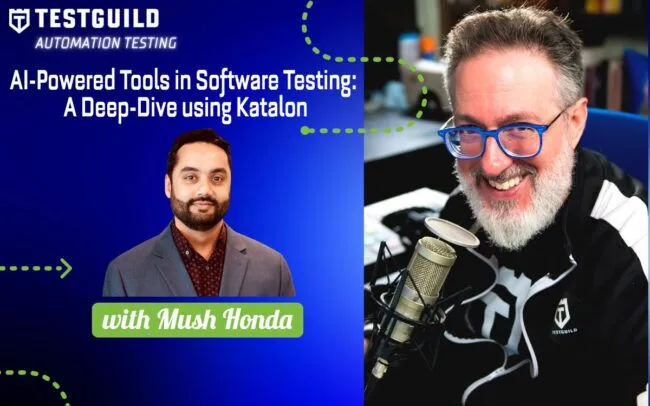
Mush Honda
Yeah. No, absolutely. And I think, just continuing on with that sort of mindset. In terms of partnering, another item I keep thinking about is, I also associate these A.I. models or machine learning models really to act as my pair programming path. What I feel it's fascinating is in the same lines, we've actually also developed another feature in that out in beta for our product Katalon Studio. It's something that we are calling as a studio assist. And what that essentially does is it leverages your LLM models. Again, you can put in your key for your OpenAI connection but then want to let you do is within your IDE, you can essentially type out the scenario that you want to test and it actually generates the code for your test automation script right there immediately for you. And what I've been doing, quite honestly, is using that almost as my programming path to be able to say, Hey, I know these scenarios. Let me create and let me label this in a certain way so that way all of my existing keywords can be leveraged. And what I found is it's almost a step up from the first leap most testers do when they first get exposed to test automation, which is record and playback. As I'm sure you've seen a lot of the low-code no-code tools that are out there for us practitioners start off by saying, Oh yeah, it's so easy to use when you actually dig into it. It's nothing more than record and playback. And what I'm seeing is with Studio Assist, while the studio platform enables you to perform record and playback, if that's what your thing is. From my perspective, leveraging studio assist using ChatGPT or OpenAI is really what it enables you to do is it enables you to step up away from that traditional record and playback because the one biggest disadvantage everything remains static, unless you go in and then say, Oh, now I want to use variables, I would use data to make my scripts more reusable, etc., etc. you're stuck. And then what this essentially lets you do is it lets you walk away from having to be tied in with just record and playback. And what I've also being able to do with it is be able to create scripts very, very easily, even without having the system on the test up and deployed environment. It's another way of thinking of it as almost shifting left, so to speak, where I can create my automation scripts preemptively, just like I would with my manual test cases, for example, and not have to worry about, well, I have to wait for the system to be implemented before I can essentially do a record and playback. It's helping even like the non-technical testers, in my opinion, to be able to leverage and get the benefit of, again, tools to be able to accelerate their life cycle. As a practitioner, I've always seen that and I'm sure you have too, is while we talk about quality being a team sport, when it comes down to roles, it's typically people starting to look to us to say, Hey, what can you do to make it more streamlined and give us confidence in the quality? I think these are tools that are very, very practical for us as practitioners to be able to apply in our day-to-day workflows.









 June 25, 2023
 37 min 27 sec
 Full transcript
 Hosted by Joe Colantonio