







 December 16, 2018
 Hosted by Joe Colantonio
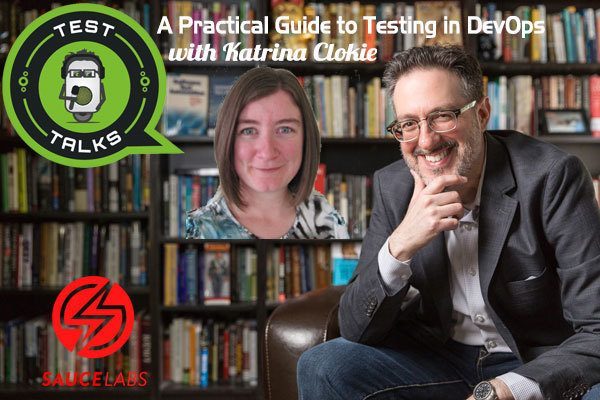
As organizations shift to a culture of intense collaboration and rapid delivery, the expectations for testers are changing. What does testing look like in an environment with automated build and deployment pipelines? How does appetite for risk change once a product can be tested in production? Who should testers look to connect with across the organization, and how can they work together effectively to deliver quality software? That's what we'll be test talking about in this episode with Katrina Clokie (click here), author of the book A Practical Guide to Testing in DevOps.
Automation Testing Podcast Automation
233: A Practical Guide to Testing in DevOps with Katrina Clokie

with Katrina Clokie
active contributor to the international testing community as the founder and editor · Testing Trapeze magazine
December 16, 2018
Hosted by Joe Colantonio
About this episode
Quotes & Insights from this Test Talk with Katrina Clokie
- I believe that a people and team focus approach is the ethos of DevOps. I see in the industry the rise of the DevOps engineer and the placement of all these responsibilities and aspirations for DevOps coming to an individual. And I don't believe that was the intent of the movement and the principles that people were trying to achieve. For me, DevOps is about that culture change and the relationships and the people.
- Tester and developed collaboration is something that we should have been already enabling in an agile environment.
- You have people from different disciplines who have to exchange knowledge, that is a good way to start building the relationships because part of creating that respectful and collaborative environment is that you value what the other people in your team do and you understand what the other people in your team do. And those practices help that exchange of information so that you do have that respect for each other's skills.
- My observation of tester developed relationships that are really fraught, often the developer's don't respect or understand what the testers are doing and that's partly because the testers themselves are really bad at explaining or sharing anything about what do because they're so accustomed to holding everything very close to their chest.
- In DevOps, I see teams that extend their pipeline so instead of stopping that pipeline at release they actually push it further and start to run some test production as part of their pipelines so it might not be all of the tests that you would run pre-release. It almost certainly won't be but it's choosing some of the tests that maybe aren't writing data, they're just doing views or they're validating existing content in your system. It's about getting a pipeline not to just drop it into production but to actually run some checks to validate that what you dropped in production is behaving the way that you think it should be.
- If you don't already know what's happening in your production environment that would be my first piece of actionable advice. Either talking to someone who supports your software in production day to day. And or trying to get access to that monitoring tools they use to figure out what's happening. That's an excellent first step. Just trying to build your own awareness of what happens after you're finished with this thing. Like what are your users actually doing and how do the people who support your software understand if it's behaving correctly or not. And just developing that understanding is a really good first actionable step.
Keep listening
Related episodes

Automation Testing Podcast · Ep. 612
Robot Framework Test Automation: Automate Web, Desktop, Mobile, and Embedded Systems
What makes Robot Framework flexible enough to test medical devices, low code bots, monitoring systems, and embedded
Nov 17

Automation Testing Podcast · Ep. 611
Playwright at Scale: Run 500 Tests in Minutes with Oliver Stenbom
with Oliver Stenbom
Is your Playwright suite slowing you down instead of speeding you up? In this episode, Oliver Stenbom,
Nov 10

Automation Testing Podcast · Ep. 610
How to Prove Your Release Is Ready When AI Writes the Code
How to Prove Your Release Is Ready When AI Writes the Code? Can you prove your software is ready to ship, or does that answer still depend on a meeting and a spreadsheet? Want to see if your team can prove a release is ready? Book a custom LoopIQ demo with Ashwin: https://testgld.link/loopiqdemo In this episode,
Nov 3

Automation Testing Podcast · Ep. 609
Why Your AI Tests Pass When Your Features Fail with Donovan Brady
with Donovan Brady
Why Your AI Tests Pass When Your Features Fail? Donovan Brady of Leapwork shows how to make
Oct 27