
 November 17, 2026
 Hosted by Joe Colantonio
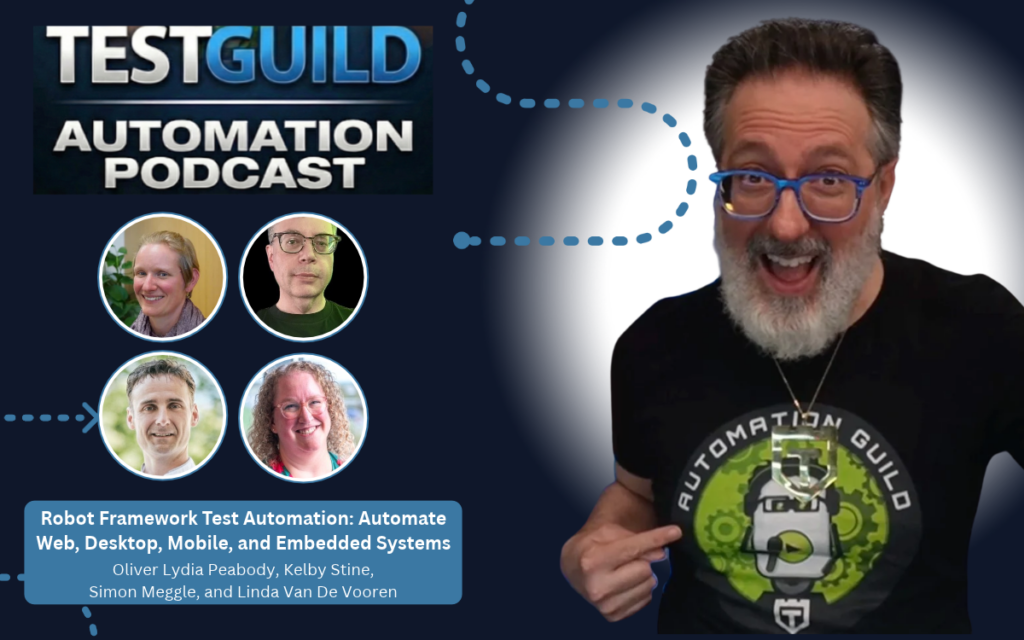


What makes Robot Framework flexible enough to test medical devices, low code bots, monitoring systems, and embedded hardware, all with one framework? In this RoboCon 2027 special, Joe Colantonio talks with four leaders in the Robot Framework community: Lydia Peabody, Kelby Stine, Simon Meggle, and Linda Van De Vooren.
They talk about why Robot Framework’s library ecosystem lets you test far beyond the browser, and how AI and the Robot Framework MCP server are speeding up test creation. They also explain why human knowledge still matters when tests break. You’ll hear how the official style guide came together, how RoboCon’s first program committee built the 2027 lineup, and the community stories that turned attendees into speakers, ambassadors, and organizers.
In this episode you’ll learn:
RoboCon 2027 runs in Helsinki, March 8 to 12, and online, April 7 to 9. Joe is hosting online again and attending in person for the first time. Register now: https://testgld.link/robocon27
Why Robot Framework Is So Flexible, and Why RoboCon 2027 Is Worth Your Time
Robot Framework gets far less buzz than Playwright, yet testers use it for everything from medical devices and low code bank robots to APIs and synthetic monitoring. In this episode, Joe talks with four people from the Robot Framework community: Lydia Peabody, Kelby Stine, Simon Meggle and Linda van de Vooren. They cover why the framework stays so flexible, how the community and RoboCon pulled each of them in, and how AI is changing the way they write and maintain Robot Framework tests. If you're deciding whether to attend RoboCon 2027, in person in Helsinki or online, this conversation gives you the honest reasons.
- Why Robot Framework's library-based design keeps it flexible after 20 years. In Simon's words, the core “in itself doesn't do anything," and its power comes from libraries that keep evolving, such as the Browser library for Playwright.
- How Lydia's team in the medical device industry built a regression suite against a simulator before the final hardware existed.
- Real projects from the guests:
- Kelby's multi-job regression suite in Azure Pipelines, and a library that turns Swagger documentation directly into keywords.
- Simon's experiment sending Robot Framework results to Checkmk through OpenTelemetry.
- Linda's regression suite around a Kofax low-code robot at a large bank.
- Flexibility is the main reason teams pick Robot Framework. Lydia's testers can move between mobile, desktop and embedded instrument projects and still get “a familiar look and feel" in their automation.
- It isn't Robot Framework or Playwright. You can use Playwright and Selenium inside Robot Framework through its libraries.
- Pair AI with knowledge. Simon says “knowledge and AI together" is a strong combination, while “AI on its own is the worst choice."
- Keep a tester in the loop. AI helped Lydia's team automate during a high-churn alpha and beta phase, but a tester still had to judge why a test broke and whether it was a real problem.
- Go for the hallway track. Linda's advice for newer users is to ask people between talks to explain what they just saw. That's where she learned the most.
Register for RoboCon now: https://testgld.link/robocon27
What is Robot Framework?
Robot Framework is an open source test automation framework that uses a readable, keyword-based language. Its capabilities come from libraries, so the same framework can drive web, desktop, mobile, API, embedded and monitoring work.Is Robot Framework a replacement for Playwright?
No. The guests describe it as a layer that can use Playwright through the Browser library, along with many other libraries, so you aren't locked into browser-only testing.Does AI work well with Robot Framework?
The guests say yes, mostly. Its keyword-based tests read like plain language, which makes it easier to turn a prompt into a test. Simon tried creating test suites with an MCP server. All of them stress that you still need to know the framework to understand why a test failed.When and where is RoboCon 2027?
In person in Helsinki, March 8 to 12, and online April 7 to 9. The in-person event ends with a Friday community day run as an open space and unconference. The online event runs three days, including one hosted by Joe, and closes with an online open space.Is RoboCon worth it if I'm a beginner?
Linda says yes. You won't follow every talk, but the people there are welcoming, and the conversations between sessions teach you a lot.